How easy do you make it or your constituents to give to you online?
I'm not talking about your "give now" button or your homepage design, but rather the design of your actual giving page mechanism and the experience your donors have when attempting to make an online gift. As we know, online giving is the fastest growing giving method, up 20% in the last year alone and as more and more people completely wire their lives, consider this report from networking company Cisco that states the increase in mobile data traffic grew 2.3-fold in 2011, more than doubling for the fourth year in a row. Average smartphone usage nearly tripled in 2011.
So I must ask you if you have looked at your online giving statistics lately? Do you know the percentage of your donors that give online? Have you tried making a gift online to your organization recently? Have you checked out your giving website on your smartphone? What is your abandon rate on your giving site? This means how many people click on your site, attempt to fill out your form and then leave without making a gift??
Part of the consulting work I do is to help people optimize their online giving and make it donor focused so I have quite a list- Here are some characteristics and samples of good giving sites for your organizations in the comments and screen shots below!
1. The site should not take long to complete, if you make it long and cumbersome with many boxes, required info and such, you are killing your rates. In addition, leave your development jargon off of this page, how do I know what a constituent means to you? And look at that scary drop down of giving choices- what do they mean? And why is unrestricted LAST?
2. Can I make a pledge and pay a pledge online? If not, why? This should be easy, if I am allowed to pledge online my gift will be larger! Also on this site there is a nifty campaign thermometer redesigned at the bottom and a link to a map so you can see where other donors are from- interactive and brilliant!
3. Is there an option for monthly giving? I want to be able to give you my card number and have you deduct a certain amount each month on a date that I specify- these gifts are larger than one time gifts and allow you to have fewer lapsed donors. This option to be reminded by Skidmore College is brilliant, so donor friendly!!
4. Can I give using my iPhone, iPad, droid or blackberry? What does your site look like on a smaller screen? Remember if you send me an email appeal and call to action, I will probably open it on my mobile device and act right away. If you make that difficult and I can't complete the transaction from my device, you've lost my money!
5. When I complete giving what do I see? I should see an immediate acknowledgment and a page where I can share the news that I just made a gift to you via integrated Facebook, twitter and other links, so I can let others know! This is so easy to do its ridiculous but we still seem to be missing it!! At the minimum take me to a page where I can join your LinkedIn group, like your Facebook page or follow you on twitter! If I just made a gift, I'm more likely to do so now!
6. Am I emailed an acknowledgment and receipt immediately? Save your paper here folks! If I'm giving to you digitally, thank and receipt me in the same manner!
7. As far as the actual payment, remember that I don't have to give you a blood sample and my first born hold in order for you to process my card! The information can be minimal, especially once I give you my CVV code! Stop making me answer 60 questions just because you want more data!
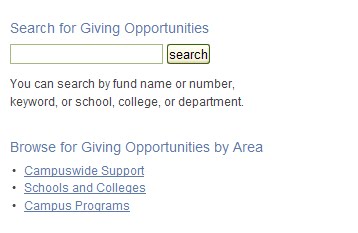
8. Do you make it easy for me to designate my funds? Is there a box I can tell you more about where I want my money to go? Look at this poor example below, why do I have to search to find what you want me to give to? This is too much work for me to give YOU a GIFT!
9. For all that is goo and holy, stop suggesting amounts to me with radio buttons! You've probably aimed too low or too high and I'm not happy about that- if I'm going online to give you $100 and you start your giving options with $25 what do you think I'm going to do? The opposite is true too, what if you overshoot and I am offended? SEE BELOW:
10. That being said, please make sure I can give you a LARGE amount online. I may need some airline miles and paying my $50,000 pledge online will help me get elite status. I've seen it happen and I've seen organizations that won't let a donor give large gifts online, or limits the type of card I can use. Don't cut off Amex jut because it costs more, it is my card of choice, especially for large gifts and if you stop me from using it, you are killing my donation amount. Remember most Amex's don't have limits!!!
I would love to hear your thoughts on this post. And yes, if you ask me offline via email I will send you a list of good, bad and mostly ugly online giving sites!
Cheers,
Lynne
Thursday, April 19, 2012
Tuesday, April 10, 2012
Is Your Research Department Using LinkedIn at all? To Its Full Potential?
Note from Me: This is coss posting of a guest blog I did that was posted live today on http://www.prospectresearch.com - they have great resources-check them out!
Lately it’s been conference season in my world, which means presentations galore! I have been doing a social media and digital technology session since 2007 but as social media gets better, so does the great info for the sessions. Recently I have stumbled upon a vast empty space for development shops when it comes to their use of LinkedIn. As I ask about the usage of it by research departments across the country I am constantly amazed at how few use it to update employment data and verify alumni titles and companies. In addition, Linked In now has advanced analytics embedded in it that can help you assess the fields and areas in which your alumni live. This data is free to any user about not only their network but also the groups they are involved with. See the graphic below for an example. It is under network statistics in the contacts portion of your profile.
Under the groups page, you can see great statistics, which also includes a tab called ‘group statistics’ that is quite revelatory. You can see that there are numerous tabs that house valuable information. Growth, seniority, function, location, industry, all can be mined and harvested for your use! Notice that LinkedIn also makes it easy for us at the bottom by saying, “Looking for group members who perform a specific professional function (e.g. sales, legal, etc.)? Members and subscribers can do advanced searches within the group.” WOW, yes, it’s that easy.
In addition, an alumni’s profile at LinkedIn is likely to be more up-to-date and more complete than the profile in the traditional database, since a professional with limited time is likely to prioritize the network where they keep track of their professional contacts over their alumni network. Also, whenever someone I know is beginning or concluding a job search, they often update their LinkedIn with their most current information even before updating their resume. Studies have shown that for those under the age of 45, LinkedIn is more than 90 percent accurate!
So I challenge you to incorporate LinkedIn analytics and searches in all of your research and data mining efforts, the total cost to you is free – the information obtained by your organization is priceless!
Lately it’s been conference season in my world, which means presentations galore! I have been doing a social media and digital technology session since 2007 but as social media gets better, so does the great info for the sessions. Recently I have stumbled upon a vast empty space for development shops when it comes to their use of LinkedIn. As I ask about the usage of it by research departments across the country I am constantly amazed at how few use it to update employment data and verify alumni titles and companies. In addition, Linked In now has advanced analytics embedded in it that can help you assess the fields and areas in which your alumni live. This data is free to any user about not only their network but also the groups they are involved with. See the graphic below for an example. It is under network statistics in the contacts portion of your profile.
Under the groups page, you can see great statistics, which also includes a tab called ‘group statistics’ that is quite revelatory. You can see that there are numerous tabs that house valuable information. Growth, seniority, function, location, industry, all can be mined and harvested for your use! Notice that LinkedIn also makes it easy for us at the bottom by saying, “Looking for group members who perform a specific professional function (e.g. sales, legal, etc.)? Members and subscribers can do advanced searches within the group.” WOW, yes, it’s that easy.
In addition, an alumni’s profile at LinkedIn is likely to be more up-to-date and more complete than the profile in the traditional database, since a professional with limited time is likely to prioritize the network where they keep track of their professional contacts over their alumni network. Also, whenever someone I know is beginning or concluding a job search, they often update their LinkedIn with their most current information even before updating their resume. Studies have shown that for those under the age of 45, LinkedIn is more than 90 percent accurate!
So I challenge you to incorporate LinkedIn analytics and searches in all of your research and data mining efforts, the total cost to you is free – the information obtained by your organization is priceless!
Friday, March 23, 2012
Imaginative and Courageous Communications
Recently at the 2nd annual ADRP NYC conference, I was fortunate enough to present the keynote address. In it, I challenged my peers and colleagues to dare to be different, to innovate beyond their current status quo, and to take calculated risks, especially with their donor communications.
Now, I present the same challenge to you, my ever faithful readership, which has now blossomed to over 4000 professionals weekly and climbing! What have you done lately to let your donors know they matter? How have you changed the way you communicate? If you haven't maybe you should....
You see all we have to do is to write brilliantly, package it superbly, and to present it in a way that will captivate, thrill and inspire.
No short order, right? Well since pictures are worth a thousand words and this Friday I seem to be short on words, I will let you know what I mean visually.
We must NOT:
Check out the title of the attachment-- Emily Post would have had a stroke!
This is an example of an organization, in this case Northwestern University, failing to understand not only proper manners and the technological savvy of their donors, or in this case non donors, but it also represents an internal dialogue about how they speak and communicate. Do you think they will ever regain those people's trust?? I think it's more of an uphill battle than they could ever recognize. What it boils down to though is carelessness. In this age of get it done now, faster, more, NOW! No one remembered that people are receiving these communications!! Good grief! It's a slap your head moment reminiscent of the failed Komen communications following their missteps.
Now, onto a positive example: this one came to me via my monthly Elle magazine. When I saw it during my morning commute, I wanted to show it to everyone on my train! But this being NYC and all, I just kept it to myself (never make eye contact on the subway). I digress.
This is not an endorsement of the Girl Scouts, this is an all out fanfare an bravo to this piece of communication! Not only is this ad striking, it is one of the best examples of donor stewardship impact I have seen in a while! The cookies are yummy looking and addictive, true, but it is the stories behind them that truly empower. Sure, I just ate 3000 calories an am now hiding the boxes because they're evidence but little Julie just earned a new badge! It's simplicity is its power. No small print, no elongated fact sheet, just simple, attractive and powerful communication.
How can you tell your story?
I now have this piece on my inspiration board as something to aspire to. What do you inspire to?
I'd love to hear your thoughts!
Cheers,
Lynne
Now, I present the same challenge to you, my ever faithful readership, which has now blossomed to over 4000 professionals weekly and climbing! What have you done lately to let your donors know they matter? How have you changed the way you communicate? If you haven't maybe you should....
You see all we have to do is to write brilliantly, package it superbly, and to present it in a way that will captivate, thrill and inspire.
No short order, right? Well since pictures are worth a thousand words and this Friday I seem to be short on words, I will let you know what I mean visually.
We must NOT:
Check out the title of the attachment-- Emily Post would have had a stroke!
This is an example of an organization, in this case Northwestern University, failing to understand not only proper manners and the technological savvy of their donors, or in this case non donors, but it also represents an internal dialogue about how they speak and communicate. Do you think they will ever regain those people's trust?? I think it's more of an uphill battle than they could ever recognize. What it boils down to though is carelessness. In this age of get it done now, faster, more, NOW! No one remembered that people are receiving these communications!! Good grief! It's a slap your head moment reminiscent of the failed Komen communications following their missteps.
Now, onto a positive example: this one came to me via my monthly Elle magazine. When I saw it during my morning commute, I wanted to show it to everyone on my train! But this being NYC and all, I just kept it to myself (never make eye contact on the subway). I digress.
This is not an endorsement of the Girl Scouts, this is an all out fanfare an bravo to this piece of communication! Not only is this ad striking, it is one of the best examples of donor stewardship impact I have seen in a while! The cookies are yummy looking and addictive, true, but it is the stories behind them that truly empower. Sure, I just ate 3000 calories an am now hiding the boxes because they're evidence but little Julie just earned a new badge! It's simplicity is its power. No small print, no elongated fact sheet, just simple, attractive and powerful communication.
How can you tell your story?
I now have this piece on my inspiration board as something to aspire to. What do you inspire to?
I'd love to hear your thoughts!
Cheers,
Lynne
Wednesday, March 7, 2012
Spreading the Joy, the Thank a Thon
I woke up this morning tired beyond belief. I didn't get home until after 10pm last night, which is really late for a girl that gets up at 5 every morning! Regardless of lack of rest, I cannot be mad. For the past two nights we have had our first ever thank a thon at my organization.
I have implemented this wherever I go and think its one of the best investments of time effort and money an organization can do. What's a thank a thon? Think the exact opposite of a phone a thon... Student callers make calls for hours on end, just to thank donors, nothing less than an honest and sincere expression of gratitude!! Calling donors just to say thanks is a magical thing, they're always waiting for the other show to drop, awaiting an ask... Surprise!! There isn't one! The students love it too because they get to express appreciation to those that have supported them directly.
So here are some tips and ideas for how to conduct your own thank a thon!
1. Segment wisely: we used 5 segments and ordered them in priority: scholarship donors, donors of 10 or more consecutive calendar years at any amount, mid level donors, first time givers, and those in our top giving society of $1 million plus lifetime cumulative 2. Separate thank you scripts were written for each group and placed at the top Of the color coded sheet, with spaces for whether or not they reached someone, voicemail or bad # and a comments section.
3. In addition I used this opportunity to acquire emails and so anyone with a blank email was asked to provide one so we could thank them digitally!
4. Follow up with those we couldn't reach or left a voicemail will be digitally through email thank yous with photos of the student callers 5. Although I was unable to do it this year, in years past at other organizations, I have invited staff, faculty, senior administration and trustees to join in and have done a reverse pyramid thank a thon. Students call the biggest donors with people like the president of the university or trustees calling first time donors or loyalty donors, imagine making a first time gift of $25 and getting a call from the chairman of the board!! It's magical!
6. For those consecutive givers I always put how many years they have given so try can be acknowledged properly, it is amazing how that special touch goes such a long way!!!
7. There is NEVER an ask... That doesn't mean we don't raise money, this year in two nights we pulled in an additional $25k from people who were overwhelmed by the simple act of being thanked... Who says stewardship doesn't make money???
8. The data acquired from these calls is valuable and is immediately updated in our database, from numbers that no longer work, to new spouses or unfortunately people who have passed on, it is a wonderful way to help cull information!
So what are (originally my phone autocorrected this to "ate"... comical) the downsides?? As you reinforce a culture of gratitude at your organization, there will be questions from donors and awkward pauses while they wait for you to make an ask that never happens, but in reality it is win win on all sides, student phone a thon callers see what it's like to be grateful, and donors are delighted by the simple act of thankfulness.
I would love to hear your stories, examples or questions!
Cheers,
Lynne
I have implemented this wherever I go and think its one of the best investments of time effort and money an organization can do. What's a thank a thon? Think the exact opposite of a phone a thon... Student callers make calls for hours on end, just to thank donors, nothing less than an honest and sincere expression of gratitude!! Calling donors just to say thanks is a magical thing, they're always waiting for the other show to drop, awaiting an ask... Surprise!! There isn't one! The students love it too because they get to express appreciation to those that have supported them directly.
So here are some tips and ideas for how to conduct your own thank a thon!
1. Segment wisely: we used 5 segments and ordered them in priority: scholarship donors, donors of 10 or more consecutive calendar years at any amount, mid level donors, first time givers, and those in our top giving society of $1 million plus lifetime cumulative 2. Separate thank you scripts were written for each group and placed at the top Of the color coded sheet, with spaces for whether or not they reached someone, voicemail or bad # and a comments section.
3. In addition I used this opportunity to acquire emails and so anyone with a blank email was asked to provide one so we could thank them digitally!
4. Follow up with those we couldn't reach or left a voicemail will be digitally through email thank yous with photos of the student callers 5. Although I was unable to do it this year, in years past at other organizations, I have invited staff, faculty, senior administration and trustees to join in and have done a reverse pyramid thank a thon. Students call the biggest donors with people like the president of the university or trustees calling first time donors or loyalty donors, imagine making a first time gift of $25 and getting a call from the chairman of the board!! It's magical!
6. For those consecutive givers I always put how many years they have given so try can be acknowledged properly, it is amazing how that special touch goes such a long way!!!
7. There is NEVER an ask... That doesn't mean we don't raise money, this year in two nights we pulled in an additional $25k from people who were overwhelmed by the simple act of being thanked... Who says stewardship doesn't make money???
8. The data acquired from these calls is valuable and is immediately updated in our database, from numbers that no longer work, to new spouses or unfortunately people who have passed on, it is a wonderful way to help cull information!
So what are (originally my phone autocorrected this to "ate"... comical) the downsides?? As you reinforce a culture of gratitude at your organization, there will be questions from donors and awkward pauses while they wait for you to make an ask that never happens, but in reality it is win win on all sides, student phone a thon callers see what it's like to be grateful, and donors are delighted by the simple act of thankfulness.
I would love to hear your stories, examples or questions!
Cheers,
Lynne
Wednesday, February 29, 2012
Social Media!
Last week I went down home, to the south, to present at CASE District III. It felt great to have a new audience, make new friends and be wrapped up in the kind of hug that only the south can give... But I digress.
The session I felt had the most pop and response from my audience was the one on social media. From the moment I began to when I finished the conversations at the bar (lol) I felt that it was one of the best I had done and one of the best audiences I have ever had! So what follows will be a short discussion of the high notes including links to articles and videos and some clever photos I steal at every moment! First, the video I show at the beginning of every social media session for those who are still wavering on the non believer side.
And a couple of explanatory photos about social media and links to some simple tutorials:
LINK: 12 Awesome Tutorials
Social media is just like a cocktail party where everyone is invited. You have the wallflowers, the listeners, the conversation starters and those who contribute content and this great mix is the human experience of interaction, just in a virtual arena and medium. Remember your first party? Scary at first, but once you figure it out and give it the old college try (irony intended) not so bad after all, pretty soon you were the one doing keg stands and jello shots, or uhm, maybe that's just me!
Regardless, if you aren't building a social media strategy just like you do a development strategy, you are missing out on a free way to engage with your constituents and to make them feel valuable and thanked. Regardless of the platform, meeting donors where they are comfortable is the first step, then shut up and listen for a while. The worst use of social media is when I read feeds or see pages that are full of news and announcements, hello?? You can and already do that on your website. Social media is not a place to regurgitate your press releases and announcements in abbreviated form. It's about a conversation, as someone just pointed out for AFP here. And you know what? Its NOT about you!!!
Social media is a place to interact, to share, to converse, like at the open bar of a networking event! It's not about what you want to say, it's about what others are saying about you and how you can join the dialogue. What does this mean for us as fundraisers? It means that social media isn't an afterthought, something you tack onto your communication plans. Social media is integrated in everything we do, how we communicate with our donors and how we live together with them supporting a common mission in a public space. It's not the solution to all of your woes, no magic bullet, and isn't going to generate millions of cash overnight. What it will do us allow your constituents to understand you, know you are listening and responding in their preferred medium and slow for an open exchange of ideas.
Don't restrict or censor your social media, being a pseudo online dictator the online community self polices just fine! But what you MUST do, is capture the information you glean from your participants. Last week I did a live demonstration of some of the free aggregate capabilities of linked in to a room of stunned folks, showing intensely valuable data on my connections while the room scribbled notes, this shouldn't have been a surprise to this room. Linked in is one of the most valuable tools that is untapped by research departments industry wide. The first thing I do upon returning home from a conference with a stack of business cards, besides writing a hand written note to everyone, is to add these new connections to my linked in profile. That way when people call me, like the two recruiters looking to hire yesterday, I have these folks at my virtual fingertips for referrals!
Ask your research department if they are updating employment information using social media, if the answer is no, ask why not? Hmmmm...
I'm getting long winded so I'll stop here for now and let you leave comments and questions for the next post...
For now here's an article on the latest social media platform we're all playing with, Pinterest...
Cheers,
Lynne
The session I felt had the most pop and response from my audience was the one on social media. From the moment I began to when I finished the conversations at the bar (lol) I felt that it was one of the best I had done and one of the best audiences I have ever had! So what follows will be a short discussion of the high notes including links to articles and videos and some clever photos I steal at every moment! First, the video I show at the beginning of every social media session for those who are still wavering on the non believer side.
And a couple of explanatory photos about social media and links to some simple tutorials:
LINK: 12 Awesome Tutorials
Social media is just like a cocktail party where everyone is invited. You have the wallflowers, the listeners, the conversation starters and those who contribute content and this great mix is the human experience of interaction, just in a virtual arena and medium. Remember your first party? Scary at first, but once you figure it out and give it the old college try (irony intended) not so bad after all, pretty soon you were the one doing keg stands and jello shots, or uhm, maybe that's just me!
Regardless, if you aren't building a social media strategy just like you do a development strategy, you are missing out on a free way to engage with your constituents and to make them feel valuable and thanked. Regardless of the platform, meeting donors where they are comfortable is the first step, then shut up and listen for a while. The worst use of social media is when I read feeds or see pages that are full of news and announcements, hello?? You can and already do that on your website. Social media is not a place to regurgitate your press releases and announcements in abbreviated form. It's about a conversation, as someone just pointed out for AFP here. And you know what? Its NOT about you!!!
Social media is a place to interact, to share, to converse, like at the open bar of a networking event! It's not about what you want to say, it's about what others are saying about you and how you can join the dialogue. What does this mean for us as fundraisers? It means that social media isn't an afterthought, something you tack onto your communication plans. Social media is integrated in everything we do, how we communicate with our donors and how we live together with them supporting a common mission in a public space. It's not the solution to all of your woes, no magic bullet, and isn't going to generate millions of cash overnight. What it will do us allow your constituents to understand you, know you are listening and responding in their preferred medium and slow for an open exchange of ideas.
Don't restrict or censor your social media, being a pseudo online dictator the online community self polices just fine! But what you MUST do, is capture the information you glean from your participants. Last week I did a live demonstration of some of the free aggregate capabilities of linked in to a room of stunned folks, showing intensely valuable data on my connections while the room scribbled notes, this shouldn't have been a surprise to this room. Linked in is one of the most valuable tools that is untapped by research departments industry wide. The first thing I do upon returning home from a conference with a stack of business cards, besides writing a hand written note to everyone, is to add these new connections to my linked in profile. That way when people call me, like the two recruiters looking to hire yesterday, I have these folks at my virtual fingertips for referrals!
Ask your research department if they are updating employment information using social media, if the answer is no, ask why not? Hmmmm...
I'm getting long winded so I'll stop here for now and let you leave comments and questions for the next post...
For now here's an article on the latest social media platform we're all playing with, Pinterest...
Cheers,
Lynne
Wednesday, February 15, 2012
Planned Giving Stewardship
What are you doing for your donors who have left their ultimate gift? Two years ago I spoke at the Planned Giving Group of New England about incorporating technology into planned giving stewardship with many raised eyebrows. So here are some things to think about... Some places send birthday cards, while these are cute and thoughtful, my Dad for one doesn't want too many reminders that his age creeps up year after year,(he now counts backwards). How about sending strategic information about best using retirement resources? You can send this cheaply by sending a postcard with a link or an email.
Yes, most planned giving donors have a computer and internet, they are the #1 growing demographic on Facebook, too, a great way for them to connect with lost classmates! How about sending them webcams or having students and staff teaching them how to Skype with loved ones near and far? My parents love to skype with me, we had a virtual Christmas this year and I got to see them open their presents live, it was fabulous! Once they have the technology and know how to use it, instead of inviting them to events, have the events come to them incorporating video chats with students, attending classes by webinar, having investment forums where they can learn from you. All of these things steward donors who are otherwise forgotten.
Are they on all of your invitation lists? They should be, even if they can't attend, the invitation and inclusiveness is meaningful. Many planned giving donors have vast life experience and would love to share that with your organization, engage them as targeted volunteers. Have them guest lecture if they are close by, use them to tell their stories in your magazines! My alma mater USC, (go gamecocks!) recently had us write congratulatory notes to recently admitted students- great stewardship of me as a volunteer and a wonderful activity for a planned giving donor to share their experiences!!
The idea here is that they not be dismissed and not engaged as a part of your donor community. These are people that have made a wonderful and lasting commitment to your organization and deserve to be celebrated. Even if you do one new thing for them, it's better than what it was! So what are your ideas? Have a plan to share? I look forward to hearing from you!
Cheers,
Lynne
Thursday, February 9, 2012
Donor Relations and Follow Through
First of all I would like to take the time and space to thank those who do generously contributed to the stewardship report swap from across the continent. In addition to posting the results HERE, I have updated parts of my site with links to great videos, donor relations websites, vendors and resources I use and more, check it out!
Lately I have been thinking a great deal about what donor relations means to our organizations, and how we as professionals can better express that to both our internal constituents and our donors as well. Boiling down our profession into an elevator speech isn't easy so this week I wanted to discuss one of the traits of a finely honed donor relations shop, follow through. At the core of what we do is build and enhance relationships. But what does that look like? For me, a big part of it is doing what I said I was going to, never letting a ball drop or a donor slip through the cracks, going the extra step to make sure the circle is complete.
Y'all might be saying, this seems pretty basic Lynne, duh! It might seem that way so let me share an anecdote that happened to me. Mr. X received a letter from his scholarship student and in turn, sent a letter to my VP asking for some more detailed information on the student and his fund. This in turn was handed over to me. I pulled all of the information together, read the student letter, a great one!, and worked on a response to the donor. Since good donor relations is in the details I also noticed that the letter came in an envelope from another university upstate. I mentioned it in my letter and off it went to Mr.X.
Four days later, I received another letter from Mr. X thanking me for my prompt response and a check for $4000. My favorite kind of letters!!! After looking up his giving history, we noticed that he gave $1000 faithfully to his scholarship every year, never more, never less. After giving a copy of the letter and gift to my VP, we decided that he should call Mr X to thank him personally for his increase. I sat in his office anxiously as he called him in his office at said upstate school. He was so gracious and warm, he hadn't had a call from a fundraiser here in a while because we believed he had made his last gift. In fact, this wasn't the case. Mr. X asked VP if he could come down for a visit and for Shabbat. He wanted to meet his student. No problem. And then the other shoe dropped, "Can I also talk to you about leaving my estate to you?" he had no children, was a professor, was about to retire, and had quite a nestegg!
You see, he had requested information from other places he donated by writing their VPs and we were the only ones to respond personally and with detailed enthusiasm. We made a difference simply through good donor relations and proper follow through. To be honest, a $1000 a year donor isn't noteworthy for us. But EVERY donor deserves the type of follow through he received. And that is good donor relations, it is also good for your metrics. Talk about tangible outcome of a stewardship effort! I can track every penny of that bequest and $4000 to our direct efforts, that isn't subjective.
So when you are evaluating and measuring the effectiveness of your program, is follow through one of your metrics? Conversely I have many stories of the reverse as well, what will your story be? I'd love to hear about it!
Cheers,
Lynne
Lately I have been thinking a great deal about what donor relations means to our organizations, and how we as professionals can better express that to both our internal constituents and our donors as well. Boiling down our profession into an elevator speech isn't easy so this week I wanted to discuss one of the traits of a finely honed donor relations shop, follow through. At the core of what we do is build and enhance relationships. But what does that look like? For me, a big part of it is doing what I said I was going to, never letting a ball drop or a donor slip through the cracks, going the extra step to make sure the circle is complete.
Y'all might be saying, this seems pretty basic Lynne, duh! It might seem that way so let me share an anecdote that happened to me. Mr. X received a letter from his scholarship student and in turn, sent a letter to my VP asking for some more detailed information on the student and his fund. This in turn was handed over to me. I pulled all of the information together, read the student letter, a great one!, and worked on a response to the donor. Since good donor relations is in the details I also noticed that the letter came in an envelope from another university upstate. I mentioned it in my letter and off it went to Mr.X.
Four days later, I received another letter from Mr. X thanking me for my prompt response and a check for $4000. My favorite kind of letters!!! After looking up his giving history, we noticed that he gave $1000 faithfully to his scholarship every year, never more, never less. After giving a copy of the letter and gift to my VP, we decided that he should call Mr X to thank him personally for his increase. I sat in his office anxiously as he called him in his office at said upstate school. He was so gracious and warm, he hadn't had a call from a fundraiser here in a while because we believed he had made his last gift. In fact, this wasn't the case. Mr. X asked VP if he could come down for a visit and for Shabbat. He wanted to meet his student. No problem. And then the other shoe dropped, "Can I also talk to you about leaving my estate to you?" he had no children, was a professor, was about to retire, and had quite a nestegg!
You see, he had requested information from other places he donated by writing their VPs and we were the only ones to respond personally and with detailed enthusiasm. We made a difference simply through good donor relations and proper follow through. To be honest, a $1000 a year donor isn't noteworthy for us. But EVERY donor deserves the type of follow through he received. And that is good donor relations, it is also good for your metrics. Talk about tangible outcome of a stewardship effort! I can track every penny of that bequest and $4000 to our direct efforts, that isn't subjective.
So when you are evaluating and measuring the effectiveness of your program, is follow through one of your metrics? Conversely I have many stories of the reverse as well, what will your story be? I'd love to hear about it!
Cheers,
Lynne
Subscribe to:
Posts (Atom)