Thursday, May 10, 2012

Skidmore College’s 24-Hour Young Alumni Challenges Nets Over 1,000 Donors

The following is a great story from Jen Castellani at Skidmore College about a recent annual giving campaign that turned out to be a HUGE success! I hope you enjoy the example of creativity and flexibility of a wonderful development staff. Congratulations to all at Skidmore!
In late March, my director of development emailed some colleagues an article about DePauw University’s recent 24-hour challenge where they secured 866 donors in a single day. Given that we were bleeding donors, I suddenly found myself scurrying to implement a similar effort with only one month to plan, market, and execute it.
Skidmore had never attempted a 24-hour challenge before, so we had no framework or benchmark. I had to start from scratch.
As a staff, we decided to focus our efforts on our most recent 20 classes. As such, all of our marketing consisted of email, social media, and word-of-mouth, beginning just a week prior to the Challenge day. Our message was simple: 501 donors on 5/01 meant $50,000 for Skidmore. (A group of committed donors pledged the $50,000 should we reach our goal). Little did we know what we were in for.
When 5/01 rolled around, we were prepared logistically. We had a Challenge website with a count-down clock and graphics to display Challenge progress. We had emailed a series of messages to our target constituents. Facebook and Twitter also helped us spread the word. Email templates had already been created to use for Challenge updates. Our social media guru had a plan for Facebook and Twitter. Additionally, our alumni annual fund volunteers contacted their classmates to inform them of the Challenge. On campus, Advancement staff was ready to make our own prospect phone calls. We were set.
Partnering with Alumni Affairs, we also arranged regional Pub Nights in NYC, Boston, and Saratoga Springs for the evening of 5/01 so that alumni could gather together to receive Challenge updates, mix and mingle, and hopefully have a great time.
By 8:00am, we already had over 40 online gifts and were astounded as the number of gifts continued to increase throughout the morning. Cow bells literally clanged with each milestone: 100 gifts, 200 gifts, 300. At noon we realized we would reach 501 donors by the end of the workday. Luckily, another challenger stepped forward, and the stakes were raised. By midnight, we needed 750 donors for $75,000. More email updates were sent. Our volunteers were energized and communicated with fellow alumni that the bar was set higher.
Internally, Advancement staff was thrilled. We were so elated as we watched our young alumni step up to the Challenge that everyone in the division participated. Even staff who were not front-line fundraisers wanted to pitch in and make some phone calls. And the cow bell continued ring each time we reached another one hundred gifts.
At 8:00pm we surpassed 750 donors. Jaws dropped when the goal then became 1,000 for $100,000. Could we really secure another 250 donors in four hours!?
Within the next few hours, alumni streamed into our Pub Night venues with cash and credit cards in hand to give—no doubt thanks to another donor who promised to match all gifts made at the events themselves.
Every few minutes I was texting volunteers and staff at each venue with an update, and they provided me with a count of gifts. Donor numbers soared!
The cow bell rang one last time shortly before midnight when the 1,000th donor gave. In the end, 1,044 donors supported Skidmore in 24 hours—the most gifts the College has every received in a day.
 If you are interested in learning more about how we marketed and/or implemented the Challenge, please contact me at jcastell@skidmore.edu.

Thursday, May 3, 2012

Corporate and Foundation Stewardship

I often receive wonderful questions from my readers (which now total an astonishing average of 5000 a week!) and from colleagues I have met at conferences near and far. This week I received a wonderful question from a former donor relations professional who has now moved into corps and founds work. Basically it boiled down to- how do I better steward corps and founds. The basic premise to my corps and founds philosophy is a simple one, the same way you steward individual donors, just in an enhanced manner. I started my development career as a grant writer writing things in 90 pages or less, in triplicate (I jest), and for faceless boards who would decide large grants. The thing is, corps and founds are not nameless faceless entities. A corporation or foundation is made up of people. Plain and simple. We steward people. We can steward corps and founds in much the same way.

Here are some examples:

1. Always write acknowledgments to not only the grant maker but also hand written notes to your contact at the corp go a long way as well, it's a relationship, just like any other that needs to be nurtured.
You need not reinvent the wheel here, many of the programs you have in place for individuals will work well for corps and founds with minor tweaks.

2. Invite corps and founds into your giving societies, especially cumulative ones. We did this with the Chevalier society at NYU Poly and the folks just loved attending events and being around our high net worth individuals and I received so many expressions of gratitude for not making them buy a table, building loyalty and appreciation.

3. Offer real impact of their giving. Not just in the required grant reporting and annual reports, but in real life. Have them meet students that benefit from their support, have lunch with faculty that are leaders in their field, etc.

4. Provide them unique access opportunities. Corporations are always looking for unique event space at low costs, your organizations and campuses are full of them. Make sure that your office or the events office is connected to their office of events and planning, it will be an invaluable relationship and mutually beneficial. Offer your leaders or faculty as facilitators or speakers for their retreats or meetings. This is expertise they would otherwise have to pay top dollar for and they will be most grateful of your thoughtfulness.

5. Have a sit down chat, especially if you are new, about the ways and names of those who should be recognized and how they would best like the recognition. Perhaps you have been sending invitations to people who no longer work there or have been ignoring their branding, this is a place where attention to detail is paramount and can build strong bridges  to the future.

6. Corporations embrace innovation and technology at in far more rapid and encompassing way than we do. Emails, blackberries and web based communications are king. Think of digitizing your invites and RSVP process, especially for this population,if you send the CEO paper invites they will get lost in a stack of thousands, and for that matter, executive assistants rule the earth. Be nice, know that they control your fate and embrace it.

7. Finally, remember that corps and founds are made up of individual people. As such they have different needs, cultures, personalities and methods. Adapt and change with each one in order to best meet their needs.

What have you done in this arena? What are your thoughts? I look forward to hearing from you soon.

Cheers,

Lynne

Thursday, April 26, 2012

Guest Post- Keep Your Writing Crisp, Clear and Concise

An old saying goes, “If I’d had more time, I would have written less.”

Think about how many emails you ignore because they look too much time to read. Long emails are disrespectful. Rather than the writer taking the time to be concise, the burden is on the reader to decipher what the note is all about. Delete. Next.

In newspapers, excess words cost money. The more words you use, the more likely you are to lose a reader and the less advertising space you have to sell.

In cyber space, wordiness can cost you reader attentiveness. Consider a 2008 study that showed the average web page visitor reads about 20 percent of the text. If your livelihood depends on people reading your website, you need to make your point succinctly.

So, my point is, less is better, if you keep your writing crisp, clear and concise. Think about how you crop a picture. Cropping forces you to identify the main, important part of the image. It takes skill, patience and creativity to crop your writing.

Here are a few suggestions and examples, with the disclaimer that these are guidelines, not absolutes. See if you can guess in each tip how I’ve discounted my own advice.

TIPS
1.          Eliminate all unnecessary words.
Example: We have seven different flavors.
Of course they’re different. That’s why there are seven of them.

Example: I love both my daughters and sons.
Not only is both unnecessary, it’s confusing. Do you have only two daughters?

2.          Use intensifiers and adverbs sparingly.
Example:             one strong verb > a weak verb + adverb
sprint > run quickly

Example: I am so tired and very hungry.
When my mother packed to move, she wrote fragile on nearly every box. Then she went to very fragile and extremely fragile. If everything is fragile, nothing is. If everything is very, nothing is. One teacher said to use very as you would damn – for emphasis only.

3.          Don’t be negative.
Besides being wordy, using negatives opens you to the risk of typing now instead of not. Moreover, people like to read positive, encouraging messages.
Example:             I am not able to attend.
                            I am unable to attend. (Avoid not.)
                           
Don’t run in the store, sweetheart.
                            Let’s walk in the store, OK? (Be encouraging.)

4.          Avoid “quotation marks,” ellipses…. (don’t forget parentheses) and exclamation points!
Example:             I don’t want to be a “pest,” but do you have that letter?
                            Going to the game will be fun (although I hope it doesn’t rain).
These punctuation marks are at best unneeded and at worst distracting. Even if it’s just for a second, the reader has to stop and figure out why they’re there.

Exclamation points, by definition, mean you are exclaiming something. Be sure that when you use them, what you’re writing is a big deal. Use them for dramatic effect, not mundane communication.

DO-OVERS
This is a system generated report with regard to donors that have given $500 (soft-credit), or more during the previous week including both primary and affiliated donors.

This system-generated report lists donors, including primary and affiliated, who have given at least $500 (soft-credit) during the previous week.

The information transmitted (including any attachments) is intended only for the person or entity to which it is addressed and may contain confidential and/or privileged material. Any review, retransmission, dissemination or other use of, or taking of any action in reliance upon, this information by persons or entities other than the intended recipient is prohibited. If you received this in error, please contact the sender and delete the material from any computer.

This email and any attachments are intended only for the addressee(s). If you received this email by mistake, please notify the sender and delete this message immediately, including attachments. If you are not the appropriate person to receive this message, distributing or reproducing it is prohibited. 

After a student fills out this form, he or she needs to submit it to our office.
After students fill out this form, they need to submit it to our office. (Use plural. It’s shorter and less awkward.)

Off my soapbox now. Wishing you success in your writing endeavors! And yes, I meant to use the exclamation point.

Debbie Meyers is director of donor services at Carnegie Mellon University in Pittsburgh. Previously, she was director of stewardship and donor relations at the University of Florida, and she held development positions at a Catholic high school and art museum. She earned a bachelor’s degree in English from Loyola University in New Orleans and a master’s degree in journalism from UF. Her OCD tendencies in writing can be traced to her mother who constantly corrected her grammar and pronunciation, and who also forbade her to wear black to weddings.

Thursday, April 19, 2012

Online giving sites ---is yours donor focused?

How easy do you make it or your constituents to give to you online?

I'm not talking about your "give now" button or your homepage design, but rather the design of your actual giving page mechanism and the experience your donors have when attempting to make an online gift. As we know, online giving is the fastest growing giving method, up 20% in the last year alone and as more and more people completely wire their lives, consider this report from networking company Cisco that states the increase in mobile data traffic grew 2.3-fold in 2011, more than doubling for the fourth year in a row. Average smartphone usage nearly tripled in 2011.

So I must ask you if you have looked at your online giving statistics lately? Do you know the percentage of your donors that give online? Have you tried making a gift online to your organization recently? Have you checked out your giving website on your smartphone? What is your abandon rate on your giving site? This means how many people click on your site, attempt to fill out your form and then leave without making a gift??

Part of the consulting work I do is to help people optimize their online giving and make it donor focused so I have quite a list- Here are some characteristics and samples of good giving sites for your organizations in the comments and screen shots below!

1. The site should not take long to complete, if you make it long and cumbersome with many boxes, required info and such, you are killing your rates. In addition, leave your development jargon off of this page, how do I know what a constituent means to you? And look at that scary drop down of giving choices- what do they mean? And why is unrestricted LAST?


2. Can I make a pledge and pay a pledge online? If not, why? This should be easy, if I am allowed to pledge online my gift will be larger! Also on this site there is a nifty campaign thermometer redesigned at the bottom and a link to a map so you can see where other donors are from- interactive and brilliant!


3. Is there an option for monthly giving? I want to be able to give you my card number and have you deduct a certain amount each month on a date that I specify- these gifts are larger than one time gifts and allow you to have fewer lapsed donors. This option to be reminded by Skidmore College is brilliant, so donor friendly!!


4. Can I give using my iPhone, iPad, droid or blackberry? What does your site look like on a smaller screen? Remember if you send me an email appeal and call to action, I will probably open it on my mobile device and act right away. If you make that difficult and I can't complete the transaction from my device, you've lost my money!

5. When I complete giving what do I see? I should see an immediate acknowledgment and a page where I can share the news that I just made a gift to you via integrated Facebook, twitter and other links, so I can let others know! This is so easy to do its ridiculous but we still seem to be missing it!! At the minimum take me to a page where I can join your LinkedIn group, like your Facebook page or follow you on twitter! If I just made a gift, I'm more likely to do so now!


6. Am I emailed an acknowledgment and receipt immediately? Save your paper here folks! If I'm giving to you digitally, thank and receipt me in the same manner!


7. As far as the actual payment, remember that I don't have to give you a blood sample and my first born hold in order for you to process my card! The information can be minimal, especially once I give you my CVV code! Stop making me answer 60 questions just because you want more data!


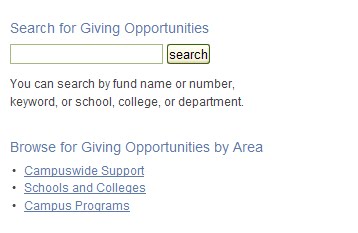
8. Do you make it easy for me to designate my funds? Is there a box I can tell you more about where I want my money to go? Look at this poor example below, why do I have to search to find what you want me to give to? This is too much work for me to give YOU a GIFT!


9. For all that is goo and holy, stop suggesting amounts to me with radio buttons! You've probably aimed too low or too high and I'm not happy about that- if I'm going online to give you $100 and you start your giving options with $25 what do you think I'm going to do? The opposite is true too, what if you overshoot and I am offended? SEE BELOW:


10. That being said, please make sure I can give you a LARGE amount online. I may need some airline miles and paying my $50,000 pledge online will help me get elite status. I've seen it happen and I've seen organizations that won't let a donor give large gifts online, or limits the type of card I can use. Don't cut off Amex jut because it costs more, it is my card of choice, especially for large gifts and if you stop me from using it, you are killing my donation amount. Remember most Amex's don't have limits!!!

I would love to hear your thoughts on this post. And yes, if you ask me offline via email I will send you a list of good, bad and mostly ugly online giving sites!
Cheers,
Lynne

Tuesday, April 10, 2012

Is Your Research Department Using LinkedIn at all? To Its Full Potential?

Note from Me: This is coss posting of a guest blog I did that was posted live today on http://www.prospectresearch.com - they have great resources-check them out!

Lately it’s been conference season in my world, which means presentations galore! I have been doing a social media and digital technology session since 2007 but as social media gets better, so does the great info for the sessions. Recently I have stumbled upon a vast empty space for development shops when it comes to their use of LinkedIn. As I ask about the usage of it by research departments across the country I am constantly amazed at how few use it to update employment data and verify alumni titles and companies. In addition, Linked In now has advanced analytics embedded in it that can help you assess the fields and areas in which your alumni live. This data is free to any user about not only their network but also the groups they are involved with. See the graphic below for an example. It is under network statistics in the contacts portion of your profile.


Under the groups page, you can see great statistics, which also includes a tab called ‘group statistics’ that is quite revelatory. You can see that there are numerous tabs that house valuable information. Growth, seniority, function, location, industry, all can be mined and harvested for your use! Notice that LinkedIn also makes it easy for us at the bottom by saying, “Looking for group members who perform a specific professional function (e.g. sales, legal, etc.)? Members and subscribers can do advanced searches within the group.” WOW, yes, it’s that easy.


In addition, an alumni’s profile at LinkedIn is likely to be more up-to-date and more complete than the profile in the traditional database, since a professional with limited time is likely to prioritize the network where they keep track of their professional contacts over their alumni network. Also, whenever someone I know is beginning or concluding a job search, they often update their LinkedIn with their most current information even before updating their resume. Studies have shown that for those under the age of 45, LinkedIn is more than 90 percent accurate!

So I challenge you to incorporate LinkedIn analytics and searches in all of your research and data mining efforts, the total cost to you is free – the information obtained by your organization is priceless!

Friday, March 23, 2012

Imaginative and Courageous Communications

Recently at the 2nd annual ADRP NYC conference, I was fortunate enough to present the keynote address. In it, I challenged my peers and colleagues to dare to be different, to innovate beyond their current status quo, and to take calculated risks, especially with their donor communications.

Now, I present the same challenge to you, my ever faithful readership, which has now blossomed to over 4000 professionals weekly and climbing! What have you done lately to let your donors know they matter? How have you changed the way you communicate? If you haven't maybe you should....

You see all we have to do is to write brilliantly, package it superbly, and to present it in a way that will captivate, thrill and inspire.


No short order, right? Well since pictures are worth a thousand words and this Friday I seem to be short on words, I will let you know what I mean visually.

We must NOT:


Check out the title of the attachment-- Emily Post would have had a stroke!
This is an example of an organization, in this case Northwestern University, failing to understand not only proper manners and the technological savvy of their donors, or in this case non donors, but it also represents an internal dialogue about how they speak and communicate. Do you think they will ever regain those people's trust?? I think it's more of an uphill battle than they could ever recognize. What it boils down to though is carelessness. In this age of get it done now, faster, more, NOW! No one remembered that people are receiving these communications!! Good grief! It's a slap your head moment reminiscent of the failed Komen communications following their missteps.


Now, onto a positive example: this one came to me via my monthly Elle magazine. When I saw it during my morning commute, I wanted to show it to everyone on my train! But this being NYC and all, I just kept it to myself (never make eye contact on the subway). I digress.


This is not an endorsement of the Girl Scouts, this is an all out fanfare an bravo to this piece of communication! Not only is this ad striking, it is one of the best examples of donor stewardship impact I have seen in a while! The cookies are yummy looking and addictive, true, but it is the stories behind them that truly empower. Sure, I just ate 3000 calories an am now hiding the boxes because they're evidence but little Julie just earned a new badge! It's simplicity is its power. No small print, no elongated fact sheet, just simple, attractive and powerful communication.
How can you tell your story?

I now have this piece on my inspiration board as something to aspire to. What do you inspire to?

I'd love to hear your thoughts!

Cheers,

Lynne

Wednesday, March 7, 2012

Spreading the Joy, the Thank a Thon

I woke up this morning tired beyond belief. I didn't get home until after 10pm last night, which is really late for a girl that gets up at 5 every morning! Regardless of lack of rest, I cannot be mad. For the past two nights we have had our first ever thank a thon at my organization.

I have implemented this wherever I go and think its one of the best investments of time effort and money an organization can do. What's a thank a thon? Think the exact opposite of a phone a thon... Student callers make calls for hours on end, just to thank donors, nothing less than an honest and sincere expression of gratitude!! Calling donors just to say thanks is a magical thing, they're always waiting for the other show to drop, awaiting an ask... Surprise!! There isn't one! The students love it too because they get to express appreciation to those that have supported them directly.

So here are some tips and ideas for how to conduct your own thank a thon!

1. Segment wisely: we used 5 segments and ordered them in priority: scholarship donors, donors of 10 or more consecutive calendar years at any amount, mid level donors, first time givers, and those in our top giving society of $1 million plus lifetime cumulative 2. Separate thank you scripts were written for each group and placed at the top Of the color coded sheet, with spaces for whether or not they reached someone, voicemail or bad # and a comments section.

3. In addition I used this opportunity to acquire emails and so anyone with a blank email was asked to provide one so we could thank them digitally!

4. Follow up with those we couldn't reach or left a voicemail will be digitally through email thank yous with photos of the student callers 5. Although I was unable to do it this year, in years past at other organizations, I have invited staff, faculty, senior administration and trustees to join in and have done a reverse pyramid thank a thon. Students call the biggest donors with people like the president of the university or trustees calling first time donors or loyalty donors, imagine making a first time gift of $25 and getting a call from the chairman of the board!! It's magical!

6. For those consecutive givers I always put how many years they have given so try can be acknowledged properly, it is amazing how that special touch goes such a long way!!!

7. There is NEVER an ask... That doesn't mean we don't raise money, this year in two nights we pulled in an additional $25k from people who were overwhelmed by the simple act of being thanked... Who says stewardship doesn't make money???

8. The data acquired from these calls is valuable and is immediately updated in our database, from numbers that no longer work, to new spouses or unfortunately people who have passed on, it is a wonderful way to help cull information!


So what are (originally my phone autocorrected this to "ate"... comical) the downsides?? As you reinforce a culture of gratitude at your organization, there will be questions from donors and awkward pauses while they wait for you to make an ask that never happens, but in reality it is win win on all sides, student phone a thon callers see what it's like to be grateful, and donors are delighted by the simple act of thankfulness.


I would love to hear your stories, examples or questions!
Cheers,
Lynne